Smart thermostats offer convenience and power saving
This is more of a “miscellaneous” category of different types of components, with the common denominator being that they allow smarter control of solutions for opening/closing, for example:
As for many of the other component categories for the smart home, smart thermostats do not constitute a homogeneous group. Depending especially in the type of heating (cooling), they can be divided into some different groups, but also other factors distinguish among the different types:
The heating (cooling) system in the home to a large degree dictates the type of thermostat, with the most common versions intended for:
Underfloor heating, where there are many alternative products to choose among, e.g., from Danfoss, Heatit, heatmiser, tado, and others. There can still be many differences among the products available, from own experience I know that one issue is whether the thermostat only allows measuring the temperature using its built-in sensor or through connected external room or floor sensors.
Radiator, where the thermostat typically replaces the old thermostat/knob on the actual radiator. Companies offering such are for example Danfoss, Elgato Eve, Fibaro, heatmiser, Honeywell, tado, and others.
Central heating, of various types, where some manufacturers of relevant products are Danfoss, heatmiser, Honeywell, Nest, etc.
Heat pump/air conditioner, where the solution for such typically utilizes the thermostat built into the heating/cooling unit, but where the remote control is replaced by a smart device that sends signals to the unit. There are fewer alternatives in this category, but relevant products are offered by AirPatrol, Sensibo and tado.
Electric panel heaters, where I have only found a thermostat from Mysa, but this requires that the heater is already controlled from an external thermostat and not by a knob on the heater itself. A somewhat simpler solution is a Mill WiFi Socket, which in practice is a smart plug with a built-in thermostat.
Degree of “smartness”, where some mainly offer remote control, while others facilitate more advanced programming, defining zones, learn how the household wants the temperature control to be implemented, etc.
Integration opportunities, where some are pretty much “isolated” while others can be included in more advanced programs and be controlled based on signals from sensors/other components in the smart home
The need for a base station, a well-known decision criterion for most components in the smart home, where some require a dedicated base station from the manufacturer of the thermostat, other can work with a more generic base station, e.g., based on Z-Wave, and some only require an internet connection
Platform/ecosystem supported, also this is a common assessment to be made for investments in the smart home, where some are based on the manufacturer’s proprietary system, others support one of the most common platforms, and some support a broad selection of these
In our smart home, we have installed smart thermostats in many rooms throughout the house (see the individual room for more detailed information about the physical setup and programming of the solutions):
- Living room, where we strictly speaking don’t have a smart thermostat as such, but a Sensibo Sky smart control unit for the heat pump
- Conservatory, here electric underfloor heating is controlled by a Namron smart thermostat
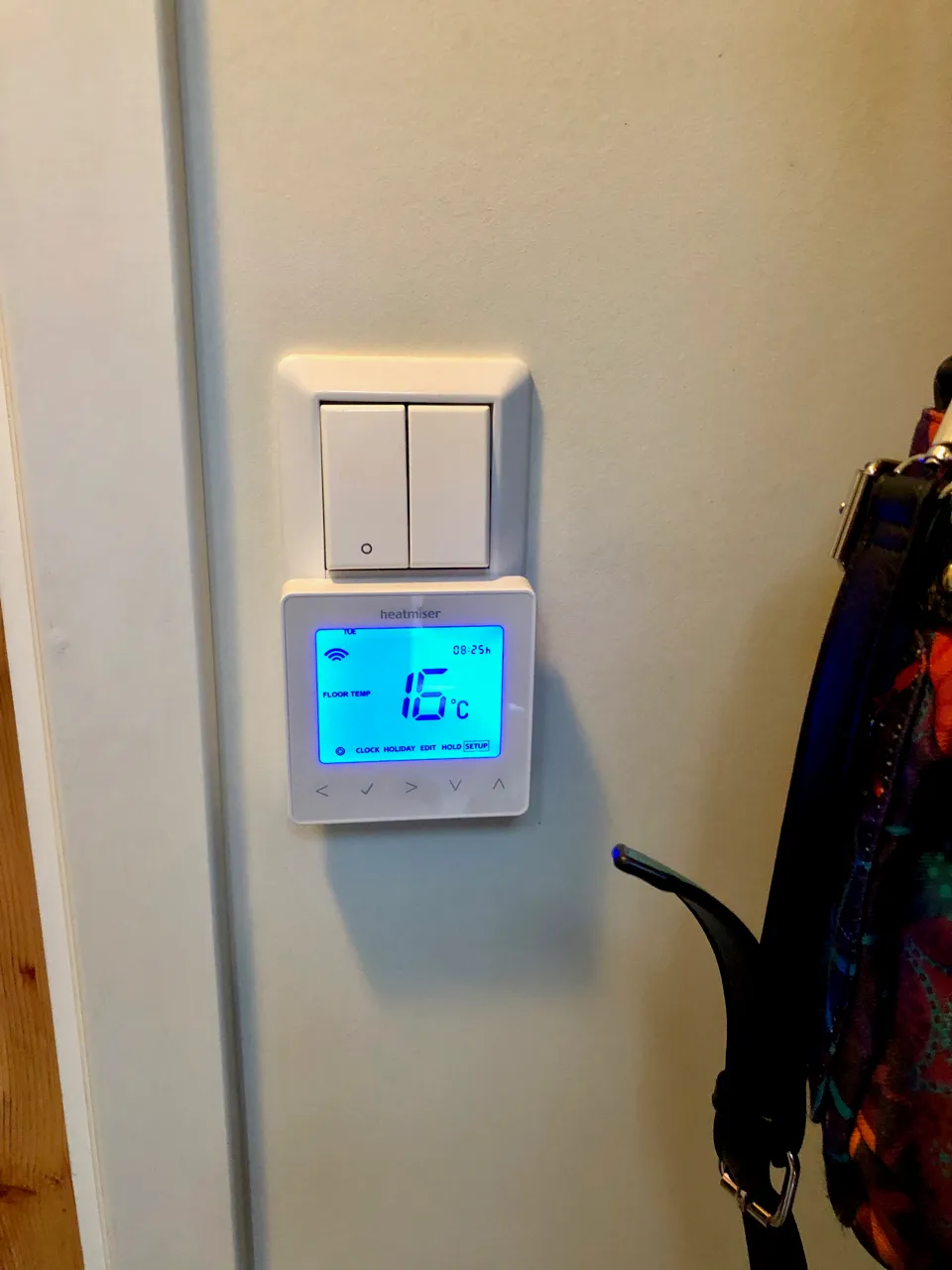
- Bathroom upstairs, also here electric underfloor heating is controlled by a heatmiser smart thermostat
- Hallway/Outer hallway, heatmiser smart thermostats control electric underfloor heating in these two rooms
- Basement living room, a Meross smart thermostat for underfloor heating
- Bathroom downstairs, surprisingly a heat miser smart thermostat controls the underfloor heating…
Contrary to many of the other types of components presented, smart thermostats are somewhat more limited in their applications, but it is still possible to outline some distinct usages:
One might think that the usage areas for smart lights are obvious, but also here it is possible to discern some distinct applications with somewhat different sets of benefits (several of these are identical to what can be achieved using either smart switches or smart plugs):
Smarter control/remote control of heating/cooling
One of the main purposes of smart thermostats is that they are connected online and can thus be controlled (turned on/off/change mode/change temperature) in different ways–from an app on a computer/smartphone/tablet/watch, with voice control using smart assistants or remote controls. In many ways, this is pure laziness, but the benefits typically materialize in three ways:
- Controlling heating/cooling without having to manually operate a physical thermostat, from anywhere in the home.
- Remotely controlling thermostats, also when away from home. This provides additional opportunities; if having left home with the temperature sett unnecessarily high or low, this can be changed from anywhere, one can turn up the temperature when leaving work so it is just right when arriving home, etc.
- And if the smart thermostat is “self-learning”, it will adapt the heating/cooling to the “rhythm” of the house, with the need for manual adjustments
For more basis control of thermostats this way, there is really no programming involved, at installation and setup, the thermostats become available for control.
Programming/automation of climate control
This is one level up in complexity and builds on utilizing the remote control capability of the thermostats to set up more or less complicated rules for when heating/cooling should be turned on/off/adjusted. Some examples are:
- Time-based, so that the temperature is adjusted based on the “rhythm” of the house when people are home and away
- Control based on signals from sensors, typically motion sensors or door/window sensors, so that rooms are heated/cooled when they are occupied or heating is turned off when a window is opened (see descriptions of usage areas for such sensors in each sensor’s page)
- Control based on location data (typically from a smartphone), so that the temperature is turned up when the first member of the household arrives to an empty house or when the last person leaves the house
Programming of simple rules based on time, sensor signals, or location data can fairly easily be set up in for example the Home app, while more advanced rules involving conditions might require more powerful apps/platforms to set up.
Integration of climate control in more extensive scenes/programs
This is not principally much different from the simpler forms of automations mentioned above, but involves that smart thermostats are included in more extensive collections of actions that can be started with one command. Such a scene/program can be activated manually, from a smartphone, tablet, smart assistant, etc., or automatically, like outlined above, based on time, sensor, location, etc. A couple of examples of such “scenes” can be:
- “Good morning” scene, activated at a fix time every weekday, can turn on selected lights throughout the home, turn on the radio, start the coffee machine, and turn up the temperature
- “Goodbye” scene, which is activated when the last person leaves the home, turns of all/most lights, lowers the temperature, turns off on any radio/TV that was on, and locks the front door
Such scenes can be programmed in the Home app or similar apps.
Power saving
This is not a usage area as such, but rather a benefit of smart thermostats. Compared with older thermostats, smart versions are typically better at minimizing the power consumption and in cases of smart thermostats that adapt to the momentary energy rate, this is even more efficient. Finally, the possibility for more convenient control/remote control increases the likelihood that home owners define more energy-efficient temperature profiles, utilizes reduced night temperature settings, etc. In sum, this can produce considerable savings.
Physical installation
In this category, the installation process will depend on which type of component to be installed:
- Thermostat for underfloor heating, this normally involves replacing an old thermostat with a smart version. This type of thermostat will basically always be connected to power, to electric heating, and possibly also external temperature sensor through wires plugged into the thermostat, and the thermostat itself installed in a wall box. Such installation should normally be done by an electrician, even though it is not a very complicated job. Issues to consider are that the thermostat must fit the existing wall box and whether it supports external room or floor sensors.
- Thermostat for radiator, I have no personal experience with this type, but as far as I can tell, installation is a relatively basic job of replacing the old one with a new.
- Thermostat for central heating, also here I have no personal experience, but installation doesn’t seem to be much different from underfloor heating thermostats, where existing wiring is reused.
- Thermostat/smart control of heat pump/air conditioner, this is probably the easiest installation. The device must be placed within IR range of the heat pump and connected to power using an ordinary power plug.