Usage areas for climate sensors in a smart home
This is a “miscellaneous” category spanning several types of sensors that measure various parameters of the surroundings and includes sensors like:
- Dedicated temperature sensors (notice that, as covered under the treatment of these, that some motion sensors and door/window sensors also can measure temperature)
- More advanced “climate sensors”, which can measure parameters like air humidity, CO level, air quality, etc. (some sensors measure one of these, others two or more in one sensor)
- More dedicated sensors, like smoke detectors, water/leakage sensors, and vibration sensors
- Weather stations, for indoor or outdoor use, which often cover many of the parameters more limited climate sensors can measure, but can also include air pressure, wind, rain, etc.
It should also be mentioned that thermostats are also a form of climate sensor, which in addition to measuring temperature (and possibly other variables) also triggers actions by itself. These are covered as a separate category.
Also this category contains a large number of suppliers and many products to choose among (see for example Aqara, Eve, Fibaro, Kaiterra, Netatmo, etc.). And since these are versatile devices, they can typically be applied for different purposes in the smart home:
Simple monitoring of different climate parameters
Many of the parameters these sensors can measure continuously er in many cases interesting simply to monitor/read the status of, without the need for taking any action based on measured levels. This obviously applies to factors like temperature outdoor or in different rooms, but also air quality, wind strength, etc. Having such sensors installed in suitable places makes reading such parameters easy, both on a screen (smartphone, tablet, watch, etc.) or having the readings read by a smart assistant.
On our part, we have implemented this type of solution some places in the house (see the individual room for more detailed information about the physical setup and programming of the solutions):
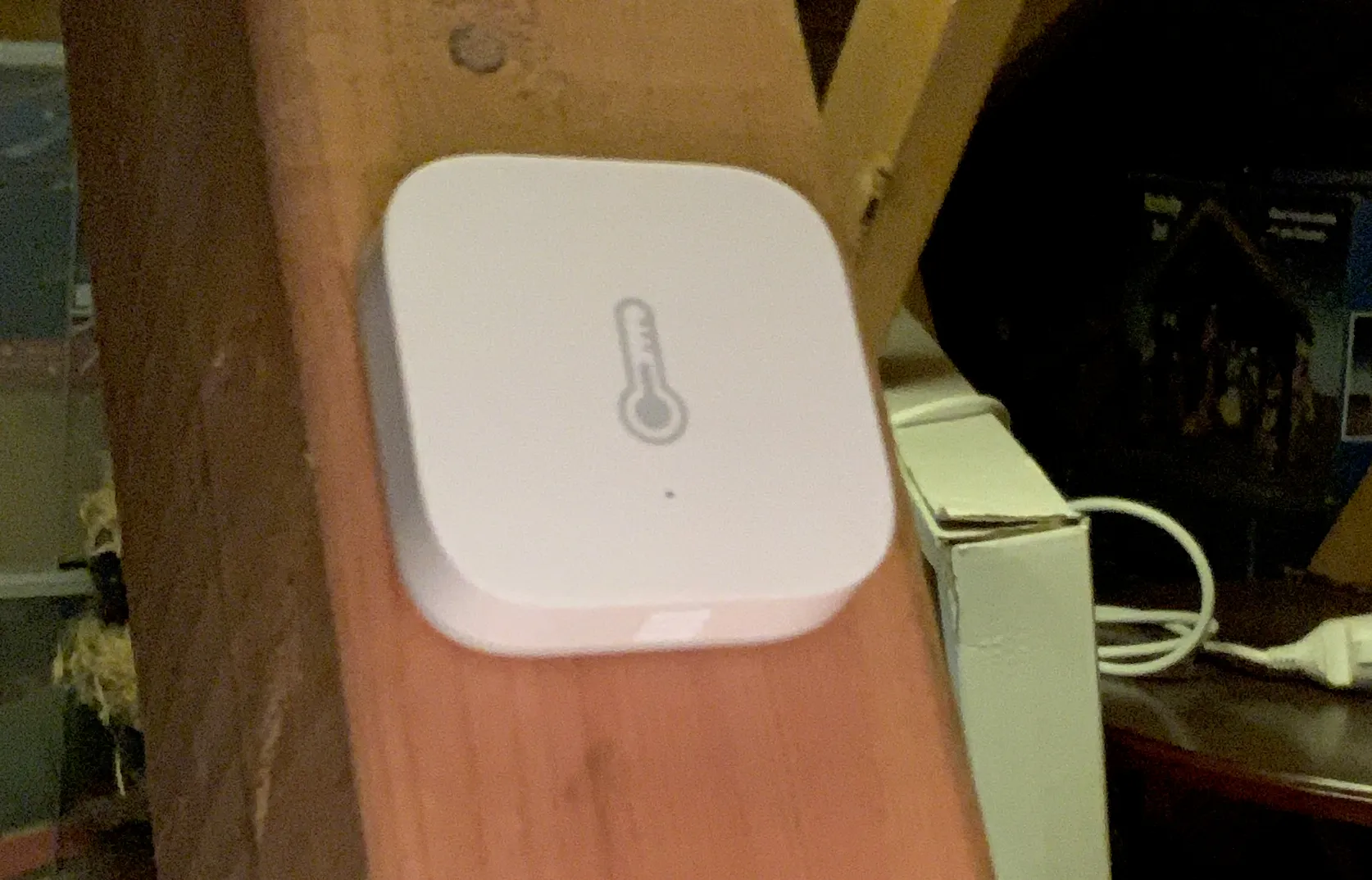
- Attic, a temperature sensor here provides information about temperature and humidity, mostly for the purpose of being able to check whether it gets below freezing here, which could damage things stored here
- Library, a smoke detector here provides information about temperature and humidity
- Living room, a smoke detector provides information about temperature and humidity while an indoor weather station gives measurements of a number of weather parameters. We also have a temperature sensor that measures the water temperature of the aquarium.
- Kitchen, a smart weather station with display measures a number of weather parameters
- Hallway, a smoke detector provides information about temperature and humidity
- Laundry room, there are two vibration sensors to check whether the washing machine and tumble dryer have completed their programs and here (or strictly speaking in the storage room accessed through the laundry room), also a temperature sensor measures temperature and humidity, also here primarily to check whether it gets below zero Celsius
- Outdoor, here the outside module of a weather station measures temperature, air pressure, humidity, and dew point while a separate wind gauge provides data about wind speed and direction
- In addition, there are several rooms where we get temperature readings from a motion or door/window sensor; office, kitchen, bathroom upstairs, master bedroom, hallway, guest room 1, bathroom downstairs and outdoor
Climate control based on climate parameters
One “step up” in the use of such sensors is to utilize the measurements for controlling heating/cooling/sun protection/etc. Many of the measurements such sensors offer are suitable for such applications, be it temperature, humidity, weather conditions, etc. and can be used to adjust temperature, turn on/off devices, etc.
On our part, we have implemented this type of solution a couple of places in the house (see the individual room for more detailed information about the physical setup and programming of the solutions):
- Living room, where an external sun screen that covers three large windows is partly controlled based on sensor data from an outdoor weather station and wind gauge. The temperature measurements are used to avoid running the screen down when it is freezing, as there could be ice in the tracks, while the wind measurements are used to open the screen again if there is wind above a certain speed. Based on the aquarium water temperature, the lights in the aquarium turn on/off.
- Master bedroom, where temperature measurements from a motion sensor are used to turn in/off a ceiling fan (on at temperatures above 20 degrees Celsius and off below 20).
- In addition, we have smart thermostats in a number of rooms, as described in that category page.
Programming of such sensor-based climate control can be done more or less complex:
- The most basic approach is of course simply to define a rule where a device is turned on/off/set to a specific state if a measured parameter goes above or below a predefined threshold. This can be done in the Home app or other apps/platforms that allow basic programming of signal-action.
- A more complicated setup typically involves combining several measurements/sensors (as our programming of the sun screen described above), perhaps setting a condition that a limit must have been exceeded over a period of time before action is taken (e.g., our sun screen is not closed until the light level limit has been exceeded for 10 minutes, to avoid it going up and down like a yo-yo), varying the threshold value during the day/year, etc. Such programming must be done in more powerful apps or Shortcuts in Apple Home, which is how we have programmed the sun screen.
Trigger actions based on climate parameters
This is perhaps a somewhat cryptic heading, but examples of such setups can be that a signal about water leak triggers closing of a valve, smoke detector warning triggers an alarm, etc.
For egen del har vi implementert denne typen løsningen noen steder i huset (se det enkelte rom for mer detaljert informasjon om fysisk oppsett og programmering av løsningene):
On our part, we have implemented this type of solution a few places in the house (see the individual room for more detailed information about the physical setup and programming of the solutions):
- Laundry room, where a leakage sensor on the floor next to the washing machine will give us a warning if it detects water on the the floor (but by now it does not trigger any automatic action, we must ourselves investigate what is happening, while a smarter washing machine might have been turned off in the case of a leak)
- Bathroom downstairs, also here we have a leakage sensor, this has been placed in the “box” where the wall toilet cistern resides, and also here detected water will give a warning (it is rumored that some companies work on smart valves that can be closed automatically)
- We also have smoke detectors in a number of rooms, library, living room and hallway, which obviously give warnings (using a siren) if they detect signs of fire
For the type of functionality we have implemented by now, i.e., receiving warnings if sensors detect something “dangerous”, this requires strictly speaking no programming; this happens by itself when the device is installed into the chosen ecosystem/using the vendor’s app. But it is possible, as mentioned, to program solutions where sensor signals also lead to more active responses than just issuing warnings, but this is not much different than programming based on signal-action, possibly modified by conditions.
Physical installation
Physical installation of different types of climate sensors is usually quite easy to do, but it can require some more deliberate placement than for other components. A water leak sensor must obviously be installed where there is the greatest risk of “stray water”, smoke detectors should be put where people will typically spend time, temperature sensors in areas where the most correct temperature reading can be made, etc.