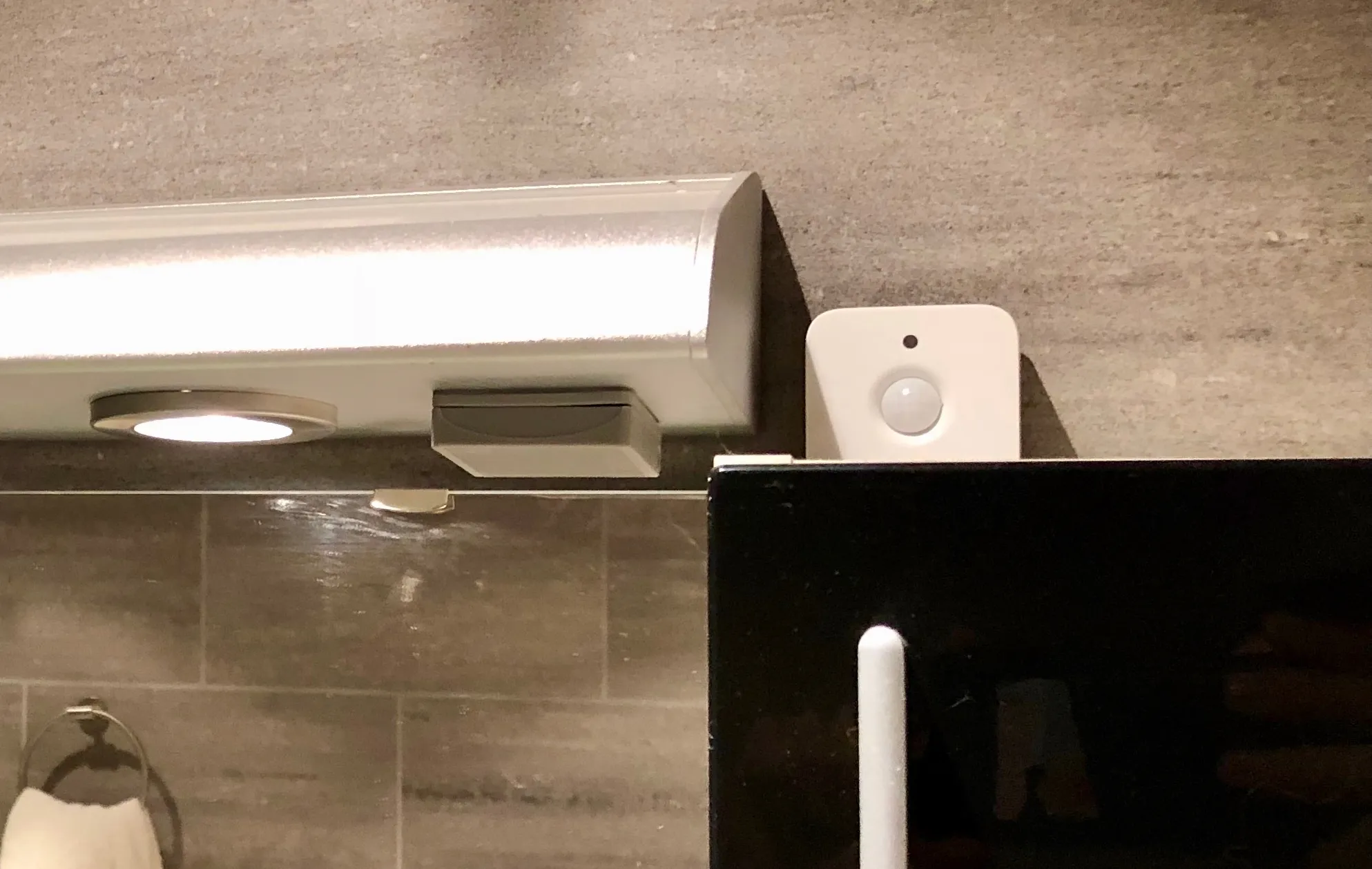
Motion sensors have many usage areas in a smart home
First of all, many vendors offer motion sensors (see for example Aqara, Eve, Fibaro, IKEA, Philips Hue, etc.), and the sensors come in different versions, from the simplest one (that only detect motion) to more advanced (which also measures temperature, light level, etc.). There are also components of various types that have a motion sensor integrated into them, e.g., light sources with their own sensor (see for example IKEA) or surveillance cameras (see for example Logitech) and a sensor that not detects the presence of people, but a smart phone (see Intellithings). Furthermore, there are sensors that not only register movement (based on infrared light), but “presence”, typically based on mmWave technology, even when the people in the room don’t move. These allow controling things more precisely, among others to avoid the well-known problem of lights turning off if staying still in a room. It is also worth mentioning that many of the benefits offered by a motion sensor can also be achieved by using a door/window sensor. Depending both on which functionality the sensor offers and which other solutions one has in the home, these are some important use cases for motion sensors:
Turn on lights when someone enters a room/zone (and often off again when the room is empty)
The primary motivation for this type of solution is partly to save energy and partly convenience. Using a motion sensor to control lights, one can be much more consistent in avoiding that lights stay on when no-one occupies the room, and the energy and money savings can be substantial. This solution works perfectly in rooms when one rarely stay for longer periods of time, like hallways, storage rooms, possibly bathrooms, and maybe even bedrooms (though with precautions against the lights turning on at night when sleeping). There is nothing preventing installing such a solution in living rooms/kitchens, but it can be “gloomy” with most lights turned off in such rooms, and also annoying if lights one wants to stay turned on automatically turn off even when being in the room, but not moving. Concerning convenience, there are many occasions when turning on lights using a manual wall switch isn’t that easy, either because one enters the room carrying something or the switch is located somewhere difficult to reach. In such cases, it makes much sense having them turn on automatically.
On our part, we have implemented this type of solution a number of places in the house (see the individual room for more detailed information about the physical setup and programming of the solutions):
- Office, which is a different types of room; here the primary light source is a (smart) desk lamp, while a ceiling light only is used if the desk lamp is off or we require more light. The latter is difficult to automate, but using a motion sensor, the ceiling light turns on if the desk lamp is off and the light level is below a defined threshold (and off again after a few minutes).
- Kitchen, this room contains a different version of motion sensor-based light control, in that the sensor is integrated into different light sources in drawers/cabinets.
- Bathroom upstairs, representing another type of room where it makes sense to keep the lights off unless someone occupies it. In addition to a simple setup where detected presence turns the lights on, this room is programmed to distinguish between full daytime light and reduced nighttime light.
- Master bedroom, which both is a type of room where it is desirable to keep the light off unless there is a need for light, but which also represents a challenge in that one does not want the light to turn on just from turning in bed at night. This has been solved by defining a condition in the programming, in our case based on whether a different light (which is always turned off during the night) is on or not. In addition, there are also here other light sources, in the wardrobes, with built-in motion sensor.
- Hallway/Outer hallway, another type of room where light is only required when actually being there. In our case, these two rooms are “linked” so that a motion sensor in each of the rooms turns on the lights in both rooms (and they turn off automatically after a few minutes).
- Basement living room, yet another room we use fairly little and where light is only required when someone is present there. Here, there are many light sources and it makes little sense for them all to turn on if someone just walks through the room or enters to pick up something. Therefore, both sensors, a presence sensor and a motion sensor, are therefore only linked to a ceiling light, which other lights must be turned on using a wall switch or the Home app.
- Laundry room (with a storage room beyond it), another room with a basic setup of motion turning on the light, and on off again after some minutes. This is a perfect example of a room where we often enter carrying something, typically a laundry basket, which makes it very convenient having the light go on by itself.
- Guest room 1/Guest room 2, in both these rooms, a ceiling light is connected to a motion sensor that turns the light on automatically when entering the room. Also here, there is a need for a solution that avoids the light going on at night when sleeping, but here it has been solved “manually” by guests having to turn off the ceiling light using the manual wall switch.
- Bathroom downstairs, also this room, which is a guest bathroom, has a simple setup with lights on at detected motion and off again when the room is empty. Also here, a solution of reduced night light could be useful, but so far I have not found a solution for this due to the way the lights are connected to the wall switches.
- Garage, another perfect case for lights based on motion, but there it is unnecessary for the ceiling lights (four fluorescents) to turn on every time we drive in/out of the garage. Thus, a condition has been set that the light only goes on between sunset and sunrise.
- Outdoor shed, we have a motion sensor to control the lights.
- Outdoor, two motion sensors here control a number of outdoor lights, as certain times of the day, to avoid having all outdoor lights stay on during the whole night (in addition to providing light level measurements to control the sun screen covering the living room windows).
Physical installation of motion sensors is normally very easy. Most, if not all, come with (often different types) of mounting kits, like double-sided tape or screws, and many of them are also magnetic. The most important consideration is where to place them, but this often is apparent from having to face them toward the door/access to the room/zone. In some cases, there might be two access routes into a room/zone, but if so it is probably easiest to install one for each, since the sensors are reasonably priced.
The programming of lights based on motion sensors can be done in (at least) three ways; two basic and one more advanced:
- The simple method, whether done in the Home app, IKEA app, or some other app/ecosystem, sets up a direct connection between the signal (detected motion) and response (light turned on)
- Still basic, but slightly more advanced involves extending this simple logic by having the light turn off again after a defined period (I have found this is easiest to do in the Home app)
- More complex programming attaches one or more conditions to whether detected motion should result in one or more lights being turned on. The conditions can be of different types, like time of the day (e.g., the light should only turn on between sunset and sunrise), measured light level in the room (most motion sensors also measure light levels), whether a different component is on/off/in a given state (e.g., to define that lights close to a TV screen will not turn on when the TV is on, to avoid light reflections on the screen), whom of the household’s members are home (based on smartphone geolocation data), etc. Some more basic conditions can be set in the Home app, but the Eve app is much more powerful for this type of programming (see control & integration for more inspiration)
Trigger other actions based on detected motion
As should be obvious from the description of programming above, it is not only lights that can be involved in setups using a motion sensor (with one exception; the IKEA motion sensor can only control lights). It is perfectly possible to create programming that has detected motion trigger a single action or a whole series of events. Some examples can be:
- Changing heating/cooling based on someone entering/leaving a room
- Activating sun protection based on motion
- Putting the whole home in “home mode” when motion is detected at the front door; turning on lights, playing radio at the desired channel, turning up the thermostat, turning on the coffee machine, etc.
- In practice, there are no limits to which actions can be triggered by motion, as long as one has smart devices or “dumb devices” connected to a smart plug
Programming of such routines is in principle not any different from programming lights, only that lights are replaced with other devices to be activated or having so-called scenes be triggered instead of individual components.
Trigger an alarm or other type of alert at detected motion
This is strictly speaking a special version of the category above, but a very useful one that deserves being mentioned on its own. If one does not have a full alarm system in the home, but still wants an alert if someone (primarily intruders) enter the garden/garage/outdoor shed/home, this can be solved using a motion sensor. It must naturally be installed to cover the area to be monitored and then programmed so that detected motion triggers some form of alert. Warnings can be given in the form of lights being turned on/flashing, music/radio/other audio source playing sound, or a siren starts yelping (for example, the Aqara base station has a built-in siren and many other vendors sell dedicated sirens). Again, the programming is much like described above for controlling lights.