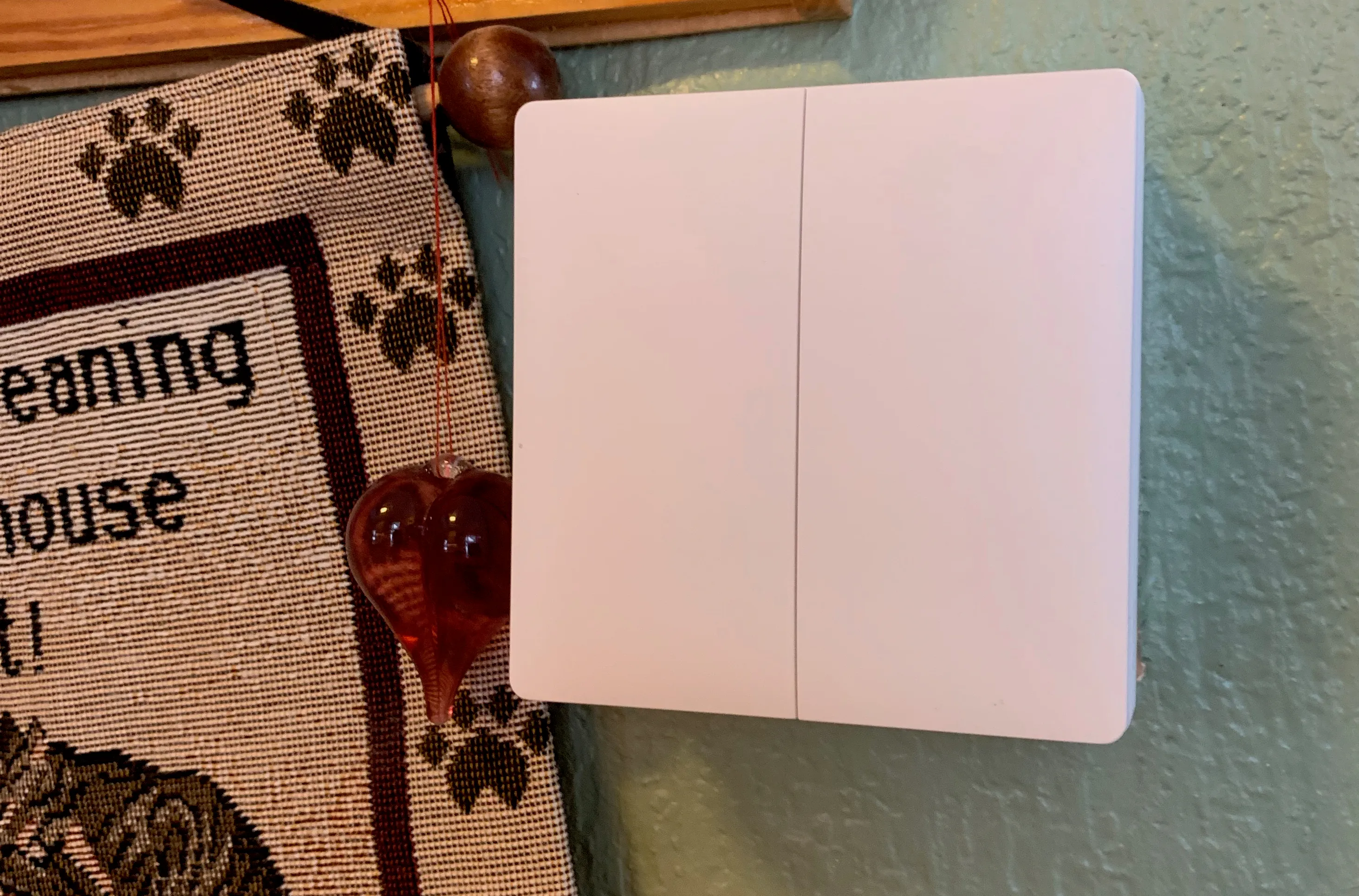
Smart switches are a varied and versatile type of component
This is a category of components that spans different types of switches, distinguished by some factors:
- Wired or wireless, smart switches come in both versions, and for cabled switches there is also a difference between switches requiring a neutral lead and not
- For cabled switches, another factor is whether the old switch itself is replaced with a new one or a smart relay is installed behind the old switch (there are even versions for the US market that are installed “on top” of the old switch)
- The number of individual switches/buttons, these devices come in versions with one or more individual switches, even up to as many as twelve
- Devices that can be controlled, this is mostly an issue for wired switches, where there are differences in types of lights and other devices that can be handled (this typically depends on the load incurred)
Hence, the choice of switch depends on the components to control, how these have been set up, usage area, etc. (and for any type of component for a smart home, the choice also depends on platform/ecosystem, communication protocol, the need for and type of base station, etc., see more under control and integration).
Since the choice of alternatives and the variation among them is so great, it is worth mentioning some examples of typical components before describing usage areas:
- Wireless switches of a more classic switch design: Some versions of this type include products from Aqara, Lightwave, and Philips Hue
- Wireless switches of a more unconventional design: The selection here is wider, with products from e.g., Eve, IKEA, Nanoleaf, and Philips Hue
- Cabled switches: Some versions are offered by Fibaro, Frontier, Koogeek, Lightwave, and Xiaoyan/Terncy
- Cabled/battery-powered relay for installation behind an existing switch: The best known supplier here is probably Fibaro, but Philips Hue has one that is powered by batteries
In our smart home, we have installed a number of different versions of smart switches, in many different rooms:
- Office, an Aqara wired switch controls the ceiling light and a wireless switch has been set up to control various devices in the room
- Library, also here we have a Aqara wireless switch, this one controls lights around the whole house through more extensive scenes as well as lights in the bathroom upstairs (the switch is placed on the wall outside the door to this bathroom), an Aqara smart wall switch with display controls other lights, including in the bathroom, furthermore an Aqara smart wired switch controls a couple of lights
- Living room, here we have three small Aqara wireless switches that control various scenes and devices and an Aqara climate sensor with switches controls various devices
- Conservatory, an Aqara wired wall switch controls a row of spotlights under the ceiling
- Kitchen, an Aqara wired wall switch controls both a ceiling lamp and a lamp above the dining table
- Master bedroom, an Aqara wired wall switch with display controls the ceiling light and an Aqara wireless switch controls lights, blinds, and other devices/scenes, while two IKEA Trådfri wireless switches control a bedside lamp
- Stairs, an Aqara wired wall switch with screen controls wall lamps
- Hallway, a Philips Hue smart relay that controls ceiling lights
- Basement living room, an Aqara wired wall switch controls a ceiling lamp, an Aqara climate sensor with switches controls various devices and an IKEA Trådfri wireless switch controls a number of lights in this room
- Laundry room, an Aqara wired wall switch controls the ceiling light
- Guest room 1, a Fibaro smart relay has been installed above the ceiling lamp and controls this and an IKEA Trådfri wireless switch controls a bedside lamp while an Aqara smart switch controls the temperature of a panel heater (via a smart plug), and finally an Aqara wireless smart switch controls lights, blinds, camera, etc.
- Guest room 2, an Aqara wired wall switch with display controls the ceiling light and an IKEA Trådfri wireless switch controls a bedside lamp while a Philips Hue wireless dimmer controls the temperature of a panel heater (via a smart plug)
- Bathroom downstairs, a Namron wired smart dimmer switch controls the lights in the bathroom, including downlights and spotlights above the mirror
- Tool shed, a Shelly smart relay switch controls a wall lamp
- Garage, an Aqara wired wall switch controls ceiling lights
Depending on the type of smart switch installed (and of course which other components are in the house), these are some important usage areas for smart switches:
Smarter control/remote control of lighting
This is the most obvious usage and also the easiest to set up (see more about smart light control under lighting). There are several ways to achieve smarter control, with somewhat different benefits, e.g.:
- Physically placing (wireless) switches/remote controls in places where they are easier to reach than existing “dumb” switches. Switches can be located by a bed, chair, door, staircase, etc. where it is convenient having a switch. Some switches are affixed to the surface and cannot easily be moved while other have a mounting plate that holds the switch (typically held in place by magnets), which allows bringing the switch to where one wants it, e.g., putting it on a table. Other versions, more of the remote control type, are not even meant for permanent installation, but is kept wherever one might find use for them. The effect achieved is in any case that such a switch is easier to reach than the old wall switch might be.
- Remotely control the switches. Mostly all the mentioned examples of smart switches allow some form of remote control, either from the manufacturer’s app, from the Home app for Apple Home, or using voice control through s smart assistant, like Google Assistant, Alexa, or Siri. This makes it even easier to turn on/off/dim the lights, both when at home and certainly when away from home.
For more basis control of lights through smart switches, there is really no programming involved, this is the basic functionality that is set up when installing the switch. But for wireless switches, when installing them, you must of course decide which lights should be controlled by the individual buttons (if the switch has more than one button) and in some cases whether these lights should be turned on/off/dimmed.
Programming/automation of light control
This is one level up and can be implemented through smart switches, but also through smart light sources or smart plugs. The principle is the same in all cases–one utilizes that remote control functionality (in this case delivered by the smart switches) to set up more or less complicated rules for when lights should be turned on/off/dimmed. Some examples are:
- Time-based light control, so that lights turn on/off at fixed times or based on the movement of the sun
- Light control based on signals from sensors, typically motion sensors or door/window sensors, which of course require the lights to be remotely controlled (see descriptions of usage areas for such sensors in each sensor’s page)
- Light controls based on location data (typically from a smartphone), so that lights turn on when the first member of the household arrives to an empty house or when the last person leaves the house
Programming of simple rules based on time, sensor signals, or location data can fairly easily be set up in for example the Home app, while more advanced rules involving conditions might require more powerful apps/platforms to set up.
Integration of lighting in more extensive scenes/programs
This is not principally much different from the simpler forms of automations mentioned above, but involves that lights are included in more extensive collections of actions that can be started with one command. Such a scene/program can be activated manually, from a smartphone, tablet, smart assistant, etc., or automatically, like outlined above, based on time, sensor, location, etc. A couple of examples of such “scenes” can be:
- “Good morning” scene, activated at a fix time every weekday, can turn on selected lights throughout the home, turn on the radio, start the coffee machine, and turn up the temperature
- “Goodbye” scene, which is activated when the last person leaves the home, turns of all/most lights, lowers the temperature, turns off on any radio/TV that was on, and locks the front door
Such scenes can be programmed in the Home app or similar apps.
Smarter control/automation of other devices
As the overview of our smart switches showed, these switches can control many other types of devices than just light sources, even if lights are the most common ones to link to them. The functionality for this differs between the types of switches, though:
- Wired switches can in principle control anything that was wired to the old, existing wall switch they replace (as long the the load involved can be handled by the smart switch, be especially aware of old-fashioned fluorescent light tubes, which are demanding for most smart switches). We control a ceiling fan this way, and often wall switches are set up to turn on/off the power to a wall outlet. This allows remotely turning on/off anything powered into the outlet, which is a way to “smarten up” devices that have no smart functionality, e.g., a radio, table fan, coffee maker, etc. (the devices must obviously work so that they are turned on when plugged into power and don’t require additional operations to start).
- Wireless switches can control any type of device integrated into the smart home and in the same ecosystem as the switch. Such switches can therefore be viewed more as advanced remote controls than traditional switches, allowing you to assign as basic or complex actions to each button as you like.
This type of control is done exactly the same way as described for lights above, with simpler actions or more advanced programming, or even part of more extensive scenes.
Physical installation
There is obviously a distinct difference between wired and wireless switches:
- Wireless switches are of course easiest to install, where the primary consideration for these is where to place them (or perhaps keep them “loose” and moved as you need to, much like an old-fashioned remote control). For switches meant to be physically mounted, there is usually in the box means for installation, typically double-sided tape or screws, and as mentioned, some are designed to consist of a mounting plate and the switch itself, often “connected” by magnets. In any case, such switches can be placed in locations where traditional wall switches are normally found, i.e., but doors, stairs, etc. However, since there is no need for wires, it is possible to more creative about the placement; for maximum comfort, they can be placed next to the bed, favorite chair, etc.
- Wired switches are not necessarily complicated to install, but in most cases it must be done by an electrician. The location gives itself since these replace (or are placed behind) existing switches, but some important considerations are whether a neutral lead is required (to ensure constant power to the switch so that it stays online), and depending on the communication protocol, distance to the base station/other devices might also be an issue, and finally also the issue of which load the switch can handle.