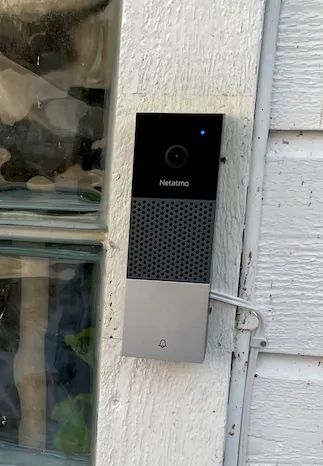
A smart doorbell is “a step into the future”
Those who have been around some time and grew up with completely traditional doorbells, which only made a sound, will probably remember the progress it was when “gate intercoms” were launched. These were arguably more used in apartment buildings, and allowed talking to whoever came to call from inside the apartment. A smart doorbell goes far beyond this; not only does it offer both video and audio, but calls can be answered from anywhere. This offers many new opportunities, but also here there are product versions differentiated by the chosen solutions and functionality:
- Wired or wireless, this is one key differentiator, both with its pros and cons. Wireless versions are easier to install, but are often physically larger and require period charging of the battery, while wired ones are typically smaller and avoid the issue of charging, but require access to power and many also presuppose an existing chime to make sound when someone rings the bell (wired one are more suitable for replacing existing doorbells).
- The camera’s resolution and “abilities”, where the video quality varies among the doorbells, from rather poor to full HD and with night vision.
- Most of the doorbells also offer two-way audio, allowing both hearing and talking to the caller, but not all of them offer this.
- The most advanced doorbells can also recognize faces so that they can inform about who is calling.
- Motion sensor, many of the smart doorbells also have built-in motion sensor which not only makes them respond to actual calls, but can also warn if someone is in the vicinity of the door and even record video of this. The most advanced versions can even distinguish between people and animals or let the user define zones where the sensor should not be triggered, e.g., a road next to the house.
- Allow pre-recorded messages to be played if a call is not answered and also allowing callers to leave a message when no-one responds.
- Available accessories, where some manufacturers offer solar chargers for wireless doorbells, separate chimes to give alerts in desired rooms, etc.
- Cost of storage for recordings, where some doorbells require a subscription to store recordings in the cloud, making only live streaming free, where others allow local storage on a memory card.
And as always, which platform/ecosystem is supported will influence the choice, as this determines the opportunities for integrating the doorbell with other devices.
This is a category that has seen a gradual increase in the number of manufacturers, but the selection is far from as large as in the case of, e.g., smart lighting or the most common sensor types. Some examples to mention are Logitech, Arlo, Nest, Netatmo, WeMo, and Robin Telecom, and it is also worth mentioning that Fibaro og Yale also offer products, but with slightly different functionality than the former ones.
In our smart home, we have (quite logically) installed only one smart doorbell in the house (see the individual room for more detailed information about the physical setup and programming of the solutions):
In our smart home, we have (quite logically) installed a smart door lock in only place in the house, but it should be mentioned that I have considered installing one at a patio door, but this seems infeasible (see the individual room for more detailed information about the physical setup and programming of the solutions):
- Outdoor, where a Reolink smart doorbell has been installed
The basic functionality of a smart doorbell is quite obvious, but it can still serve some different purposes and offer different types of benefits:
More convenient operation/remote operation of the doorbell
To be able to operate a component from anywhere, either at home or away, is useful for many types of components in the smart home, but perhaps the benefits are among the greatest for a smart doorbell:
- Partly this offers, even when at home, the opportunity for answering the doorbell without having to go to the door. This can of course be useful is doing something that is difficult to take a break from, if it will take a long time to reach the front door, one is not “presentable”, or unsure whether it is safe to open the door. This is most convenient and if there is a need for actually coming to the door, this can of course be done after having first responded to the call remotely, or possibly opening the door if a smart door lock has been installed.
- And partly, if not at home, one avoids missing calls, be it from family, friends, or somebody making deliveries. The doorbell allows responding to the call, both seeing and talking to the caller.
- Even more important is the security aspect of this. It is a well-known method applied by people with dishonest intentions to ring the door and checking whether someone is home, and in the worst case, break in if nobody answers the door. With a smart doorbell, it is possible to answer literally be anywhere in the world and still respond as if being home, thus preventing the threat of burglars.
- Another convenience is that the doorbell camera can be used as a “weather checker”, if there is no other smart camera installed in the home that can display images from outdoor, a smart doorbell is an easy way to check whether it is raining, snowing, etc., even when away.
For basic operation of smart doorbells, in the form of answering calls, there is no actual programming involved, this is set up during installation.
Provide security functionality/form of a security system
This is partly covered above by giving an impression of being home even when away, but a smart doorbell can offer additional functionality related to security issues:
- For doorbells with built-in motion sensor, it is possible to get a warning if someone is moving about around the house (some of the doorbells cover a quite wide area around the door), even if they don’t ring the bell. If motion is detected, the doorbell can then be used to talk to the “intruders” and scare them away, should they have nefarious intentions.
- Many smart doorbells can be programmed to record whatever the camera captures, either if someone rings the door (even without answering the call) or the built-in motion sensor detects motion (or even an external motion sensor warns that someone is on the property). This provides documentation if it turns out that something was stolen or damaged.
- Furthermore, signals from the built-in motion sensor can be used to trigger other warnings/actions (see more about this under motion sensor), e.g., turning on an outdoor light, starting a siren, etc.
Some of this can be set up in the manufacturer’s app while more advanced rules involving conditions might require more powerful apps/platforms to set up.
Integration of the doorbell with other devices
This is arguably not the area where smart doorbells distinguish themselves, but there are some opportunities:
- Programming the system so that when someone rings the doorbell, this not only sends a notification to a smartphone/tablet/watch/etc., but also flashes lights in the home or mutes the TV audio.
- Exploiting the built-in motion sensor like any other type of motion sensor, e.g., to turn on lights in the home when motion by the front door is detected (unless the lights were already turned on), starting a “Welcome Home” scene that prepares the house for “habitation”, etc.
More creative people will probably see other opportunities. Such integration can typically be programmed in the Home app or similar apps.
Physical installation
This is mostly depending on whether the doorbell is wired or wireless:
- For a wireless version, it is primarily a question of finding a suitable place to put it (at the right height above ground, preferably with some protection against the weather, with sufficient network coverage) and installing it using the mounting gear that comes with it. I have not studied the different alternative products, but for our Ring doorbell, I first had to install a mounting bracket, then attach the doorbell itself to the bracket using “safety screws”. If accessories are to be installed, e.g., solar charger, this typically requires some more space and a location where the doorbell is exposed to sunlight.
- In the case of a wired doorbell, there are some additional issues to consider. Also here, a suitable location must be found, with the exact same requirements as for a wireless one, but also with access to wired power. This might also be work that an electrician should perform, and some versions might require an existing chime (or one must be installed) to make sound when someone calls.