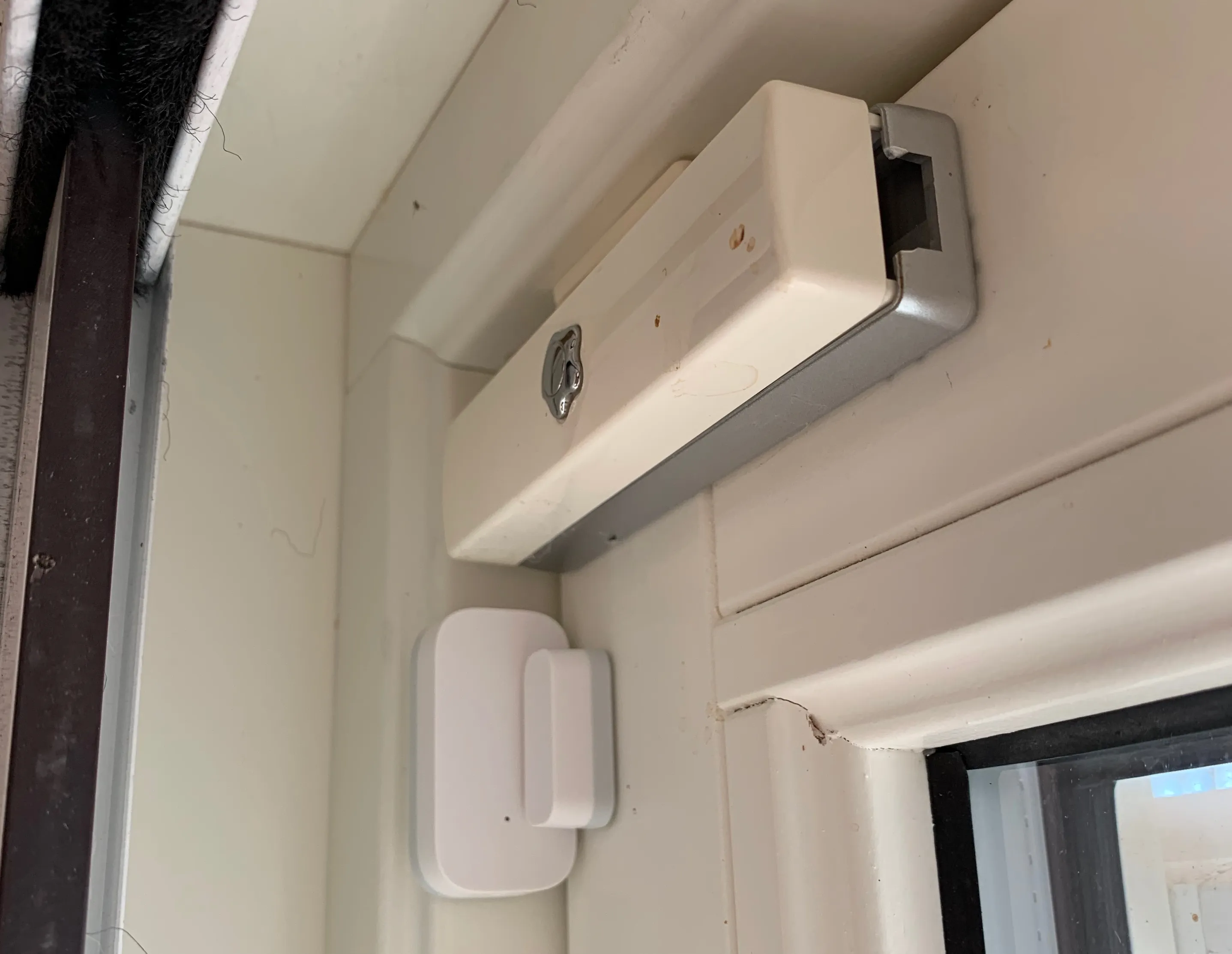
Door/window sensors have many usage areas in a smart home
As for motion sensors, there is a large number of vendors and products on the market (see for example Eve, Fibaro, IKEA, Philips Hue, etc.) and also these sensors come in different versions, from the simplest one (that only detect opening/closing) to more advanced (which also measures temperature, detect “shock”, e.g., heavy blow to a window, and display opening/closing history). Also this type of sensor can be used for different purposes in the smart home:
Turn on/off lights when a door/window is opened/closed
Just like for light control based on motion sensors, the primary motivation for this type of solution is partly to save energy and partly convenience. Such sensors can be installed on a front door, an internal door, or even a cabinet door. Using such a door sensor to control lights (it is probably less relevant to control lights based on windows), one can both avoid lights staying on in empty rooms and it is very convenient having lights turn on/off automatically when a door is opened/closed. Contrary to when this is based on motion sensors, which means the light stays on as long as there is movement in the room, it can be challenging that a door sensor turns the light off when the door is closed. This means that this approach is mostly suitable in rooms where the door is opened to do something in the room (with the door staying open when performing the errand) and then is closed again when done.
On our part, we have implemented this type of solution several places in the house (see the individual room for more detailed information about the physical setup and programming of the solutions), for example:
- Hallway, here a door sensor installed on the door to a shoe closet under the staircase controls a lamp in this closet (the lamp is connected to a smart plug)
- Bathroom upstairs, a sensor on the shower door is used to stop the lights from turning off when someone is in the shower
- Attic, a contact sensor installed on the attic hatch controls the lights
- Tool shed, a door sensor on the shed door turns on/off the light at opening/closing
- Outer hallway, here there is a sensor on the front door and this turns on the lights both in this room and the adjacent hallway
- Garage, where sensors mounted on the garage doors turn on the ceiling light when a door is opened after sunset
Climate control based on door/window state
In addition to light control, this is probably the most obvious use of door/window sensors, and perhaps is climate control the most important usage. The basis for claiming this is partly that light control in many cases is more suitably done using a motion sensor and partly that heating/cooling is closely linked to whether a door or window is open; one obviously wants to avoid that one the one hand a window is open for cooling and on the other hand a heat pump/heating panel/other heating source tries to compensate the cooling by turning up the power.
On our part, we have implemented this type of solution several places in the house (see the individual room for more detailed information about the physical setup and programming of the solutions):
- Office, here a sensor has been installed on the window and programmed so that if the window is opened, the electric panel heater is turned off (and on again when the window is closed).
- Living room, our heat pump is located here and this is linked to a door sensor on a patio door in the living door, but also to a veranda door in the library and a window sensor in the kitchen. This is programmed so that if one of the doors or window (or several of them) is opened, the heat pump is turned off. If all the doors/window is closed, the heat pump is turned on again.
- Guest room 1/guest room 2, a window sensor controls an electric panel heater (via the smart plug it is connected to, the heater is rather old and not on-line itself) and on again when the window is closed. The oven is controlled by a built-in thermostat so it takes care of itself, the window only controls whether it gets power or not.
Programming of climate control based on door/window sensors can also be completely basic, but can also be made more complicated:
- The basic method is exactly like programming lighting control; detection of a door/window being opened turns off the heating/cooling unit and on again when the door/window is closed.
- A little more advanced involves connecting two or more door/window sensors in the programming, as I mentioned for the control of our heat pump, where closing of one of the doors is checked against the other door/window and the heat pump only turned on when all these are closed. This can, at least today, not be set up in the Home app, but the Eve app or other more advanced platforms allows defined such conditions before a signal leads to action being taken.
- Even more advanced programming means linking other conditions to signals from door/window, like time of day (e.g., that heating is only done in the evening), whether another component is on/off (e.g., to avoid that both underfloor heating and a panel heater are on simultaneously), whom of the household’s members are home (based on smartphone geolocation data), etc. Some more basic conditions can be set in the Home app, but the Eve app is much more powerful for this type of programming (see control & integration for more inspiration).
Alarm functions based on door/window sensors
The last obvious usage of this type of sensors is linked to security and alarm. Door/window sensors are a highly common type of component used in alarm systems and are of course used to detect whether a door or window is opened by intruders, and more advanced sensors can also detect it if someone bangs on a window to try to break it. This type of setup is easiest to achieve as part of a dedicated alarm system, but can also be set up in a more general smart home system. In such a case, the programming must be set up so that signals from a door/window being opened leads to alerts in the form of, e.g., flashing lights, an audio source turned on, or sounding of a siren. The challenge is to define conditions so that one avoids triggering an alarm when opening a window oneself.
Physical installation
Physical installation of door/window sensors is normally very easy. Most, if not all, come with (often different types) of mounting kits, like double-sided tape or screws. The most important consideration is where to place them, they can in principle be mounted anywhere along the frame, both on the sides and the upper/lower frame (the lower frame is not very convenient in doors), but take care to not put it somewhere it risks being knocked loose.