Smart plugs (and smart power strips) are useful in a smart home
Like most of the other component categories, also this one spans some different types of plugs/strips, distinguished by some factors:
- Wired or wireless, where the former involves replacing the existing power outlet with a smart version while a wireless smart plug is simply put “between” the existing power outlet and the device to be connected (the latter is by far themes common type)
- Single or multiple outlets, where a single smart plug is very small and installed directly into the wall outlet while a smart power strip is connected to the outlet by means of shorter og longer cable between the strip and the power plug (such smart power strips can offer both regular power outlets as well as USB ports)
- Indoor or outdoor use, though with a smaller selection of devices suitable for outdoor use
- Additional functionality beyond smart power outlets, where many versions also measures power consumption. There is also a version with a built-in thermostat, Mill WiFi Socket, made to control electrical heaters without any remote control capability.
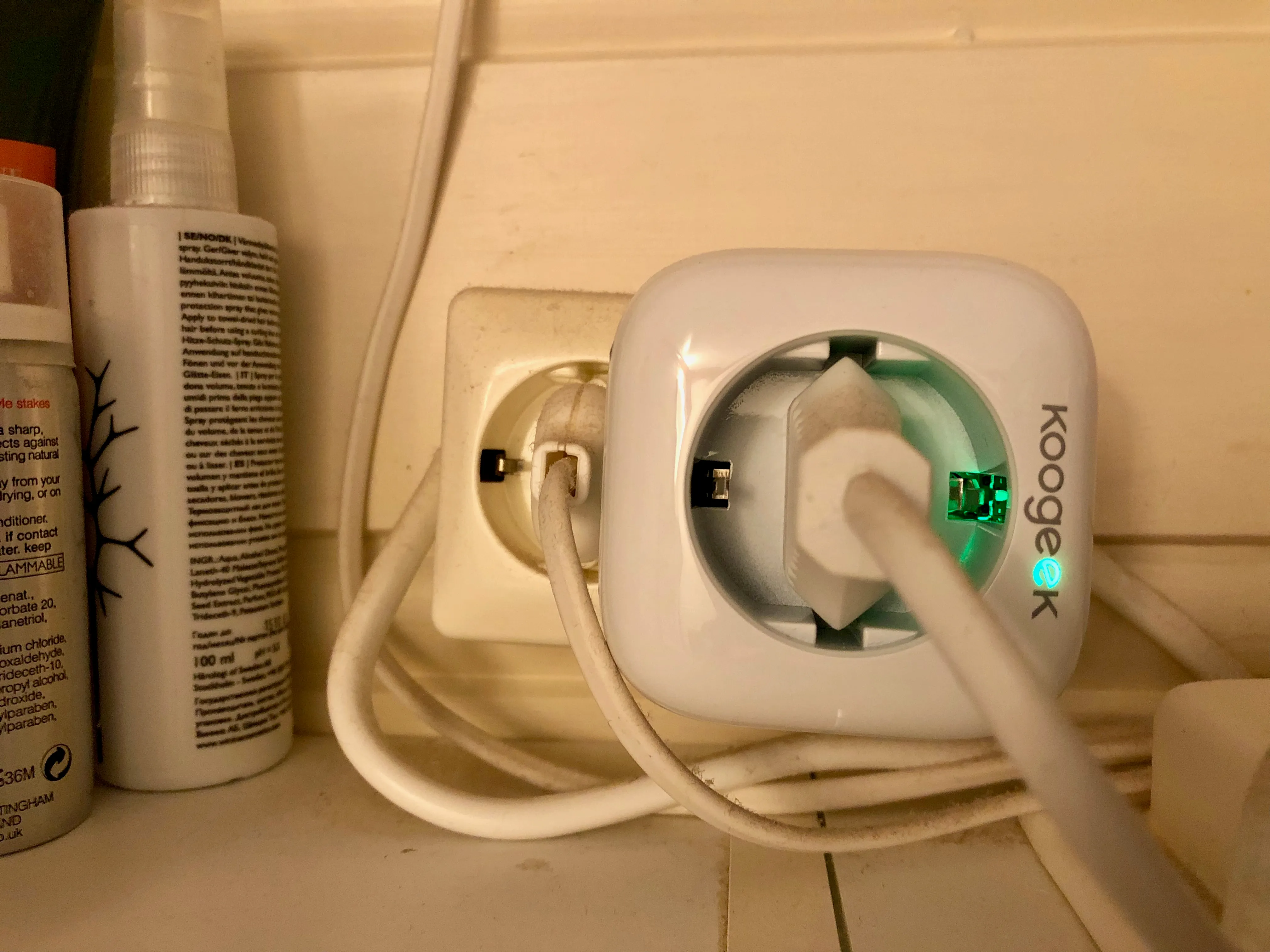
With a small reservation, I venture that this is the category with the broadest selection of vendors and products to choose among–if reviewing the various vendors presented on these pages, one will quickly notice that many of these offer one or more smart plugs. We have experiences with some of these; Eve, Fibaro, IKEA Trådfri, Koogeek, and Nexa. When choosing a smart plug, the decision, as for most components, depends very much on which platform/communication platform the smart house is built on, the desired functionality, and price (there are significant differences in price among the alternative products available).
In our smart home, we have installed a number of different versions of smart plugs in many different rooms (see the individual room for more detailed information about the physical setup and programming of the solutions):
- Attic, two IKEA Trådfri smart plugs control light sources
- Library, an IKEA Trådfri smart plug controls a painting light and a Connecte smart power outlet controls a set of LED lights
- Office, an IKEA Trådfri smart plug controls the light in a globe
- Living room, two Namron smart power strips (which also has two USB A outlets, used for charging phones and tablets) controls several lights and aquarium equipment
- Conservatory, an Elgato Eve smart plug controls a floor lamp and a Nexa plug allows rebooting the Velux Gateway
- Basement living room, two IKEA Trådfri smart plugs control a number of lamps while another Trådfri plug does the same for the other IKEA Trådfri Gateway
- Guest room 1, where one of the Mill socket version mentioned above is used to control a traditional Siemens electric panel heater
- Outdoor shed, two IKEA Trådfri smart plugs control a set of LED spotlights as well as a camera, the latter allows rebooting the camera, which tends to freeze up
- Outdoor, where a Nexa smart plug controls a greenhouse heater
No matter which type chosen, smart plugs/smart power strips have many usage areas. And not surprising, since the basic functionality of a smart plug and smart switch is identical, i.e., turning on/off the power to a connected device, the usage areas are also mostly identical:
Smarter control/remote control of lighting
As the list above shows, a number of different devices can be connected to a smart plug (se more about this below). Nevertheless, different forms of lighting is arguably the most obvious and most common type to be combined with smart plugs, providing a number of benefits:
- Controlling lights without having to ise physical switches. Without any form of smart lighting installed, the only way to control lights is to operate them manually using the switch on the light itself or a wall switch. This has obviously worked since electricity was invested, but with smart plugs, this can be done more elegantly/conveniently. All smart plugs allow some form of remote control, either from the manufacturer’s app, from the Home app for Apple Home, or using voice control through s smart assistant, like Google Assistant, Alexa, or Siri. This offers the opportunity to control lights from wherever in the home with a phone/tablet/voice/etc.
- Remotely controlling lights. Not only can this be done when at home, but not in the least when away from home. This provides additional opportunities; if lights have inadvertently been left on, they can be turned from anywhere, lights can be turned on/off to fool people into believing someone is home even when on vacation, etc.
- An addition benefit of this solution is that it allows monitoring power consumption. Many of the smart plugs for sale now offers this functionality, monitoring momentary usage, seeing consumption history, and even defining limits for how much power can be used in a period and having the plug turn off power when the limit is reached. This doesn’t only apply to lighting, but to any device connected to the smart plug.
For more basis control of lights through smart plugs, there is really no programming involved, this is the basic functionality that is set up when installing the plug/power strip and choosing which devices to connect to it.
Programming/automation of light control
This is one level up in complexity and can be implemented through smart plugs, but also through smart light sources or smart switches. The principle is the same in all cases–one utilizes that remote control functionality (in this case delivered by the smart plugs) to set up more or less complicated rules for when lights should be turned on/off. Some examples are:
- Time-based light control, so that lights turn on/off at fixed times or based on the movement of the sun
- Light control based on signals from sensors, typically motion sensors or door/window sensors, which of course require the lights to be remotely controlled (see descriptions of usage areas for such sensors in each sensor’s page)
- Light controls based on location data (typically from a smartphone), so that lights turn on when the first member of the household arrives to an empty house or when the last person leaves the house
Programming of simple rules based on time, sensor signals, or location data can fairly easily be set up in for example the Home app, while more advanced rules involving conditions might require more powerful apps/platforms to set up.
Integration of lighting in more extensive scenes/programs
This is not principally much different from the simpler forms of automations mentioned above, but involves that lights are included in more extensive collections of actions that can be started with one command. Such a scene/program can be activated manually, from a smartphone, tablet, smart assistant, etc., or automatically, like outlined above, based on time, sensor, location, etc. A couple of examples of such “scenes” can be:
- “Good morning” scene, activated at a fix time every weekday, can turn on selected lights throughout the home, turn on the radio, start the coffee machine, and turn up the temperature
- “Goodbye” scene, which is activated when the last person leaves the home, turns of all/most lights, lowers the temperature, turns off on any radio/TV that was on, and locks the front door
Such scenes can be programmed in the Home app or similar apps.
Smarter control/automation of other devices
As the overview of our smart plugs showed, these switches can control many other types of devices than just light sources. In principle, anything connected to the smart plug can be controlled (as long as the plug can handle the load involved). We control an electric panel heater and a camera this way, but the opportunities are also endless, e.g., a radio, table fan, coffee maker, etc. (the devices must obviously work so that they are turned on when plugged into power and don’t require additional operations to start).
This type of control is done exactly the same way as described for lights above, with simpler actions or more advanced programming, or even part of more extensive scenes.
Physical installation
For wireless smart plugs/smart power strips, there is strictly speaking no “installation” involved, they are just plugged into the chosen power outlet and then appear on-line. A couple of issues are still worthwhile being aware of. Partly, remember that the smart plug requires constant power, meaning that power outlets controlled by a wall switch are less suitable in that the smart plug will lose power and thus connection if the wall switch is (inadvertently) turned off. And depending on which smart plug is used (especially regarding physical dimensions) and where the power outlet is located, the end result could be a “Christmas tree”. I was about the install a smart plug in an outlet by the ceiling, with the idea of using a double extender to powering two lamps. The wife disagreed…
If choosing the route of replacing existing power outlets with smart editions, this if course requires some more effort. They are not necessarily complicated to install, but the work must be done by an electrician. The location gives itself since these replace existing outlets.